Sudan
Throughout several civil wars, Sudan has experienced high levels of violence and unrest, particularly in Darfur. Extending coverage of a minimum basic package of primary health care services (BPPHS) to facilities in all Sudan is a need that will be addressed by the Health Sector in coming years. Continuing population displacement from neighboring countries and access constraints will likely increase the need for strong preparedness and timely response to communicable disease outbreaks including measles, acute watery diarrhoea, hepatitis E and scabies. Maternal and infant mortality will continue to be a priority problem particularly among vulnerable populations.
Following a consultation among IASC Principals, agreement has been reached to extend the system-wide scale-up for Sudan for a further six months, until 30 June 2026.
The IASC system-wide scale-up for Sudan was first activated on 29 August 2023 and had most recently been extended through 31 December 2025.
The information displayed here is updated in reference to the Health Cluster dashboard, in quarterly periods.
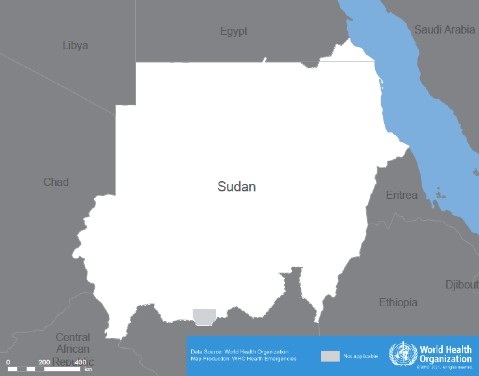
Map disclaimer: Data source: WHO. Map production: WHO/Health Emergencies Programme. @ WHO 2021. All rights reserved.
Formal Health Cluster System (IASC declared) data as of June 2026
 | 21 millionPeople in Need |  | US$325 million requested247m Prioritized |  | 2009 year activated |
 | 6.6 millionPeople Targeted5.1M Urgently prioritized |  | 36% funded |  | Co-coordinatorRelief International |
Health Cluster coordination
Health Cluster team
National team: 2
Coordinator: 1 FT
Information management officer: 1FT
Public health officer: 0
Communications officer: 0
Subnational hub: 3
Health Cluster partners
Partners: 52
International NGOs: 23
National NGOs: 14
UN agencies: 4
National authorities: 1
Donors: 4
Observers: 6